Foundation Settlement Starts Years Before the First Crack Appears
Most property owners discover foundation settlement the same way: a door that starts sticking, a crack that appears above a window frame, a floor that no longer feels quite level. By that point the problem has a name, a visible symptom, and a repair bill attached to it. What it also has — though this is the part that rarely gets discussed — is a history. Foundation settlement does not begin the day the crack appears. It begins months or years earlier, in millimetres of movement that are invisible to any inspection and undetectable without the right monitoring in place.
That gap — between when foundation settlement starts and when it becomes visible — is where the financial damage accumulates. The soil moves. The structure responds. The repair cost grows. And the property value erodes, quietly, before anyone has called a structural engineer or scheduled an inspection.
SkyIntelGroup works with property owners, developers, facility managers, and real estate investors to close that gap using satellite-based deformation monitoring that detects millimetre-scale movement across an entire building footprint — before the first visible sign appears, and long before the first invoice from a foundation contractor.
What Foundation Settlement Is — and the Difference That Determines Whether It Destroys Value
Every building settles. This is not a problem — it is physics. When a structure is loaded onto soil, the ground beneath compresses under the weight. Engineers design foundations to accommodate this. In most buildings, on most soil types, the bulk of this initial settlement happens in the first months after construction and then stops.
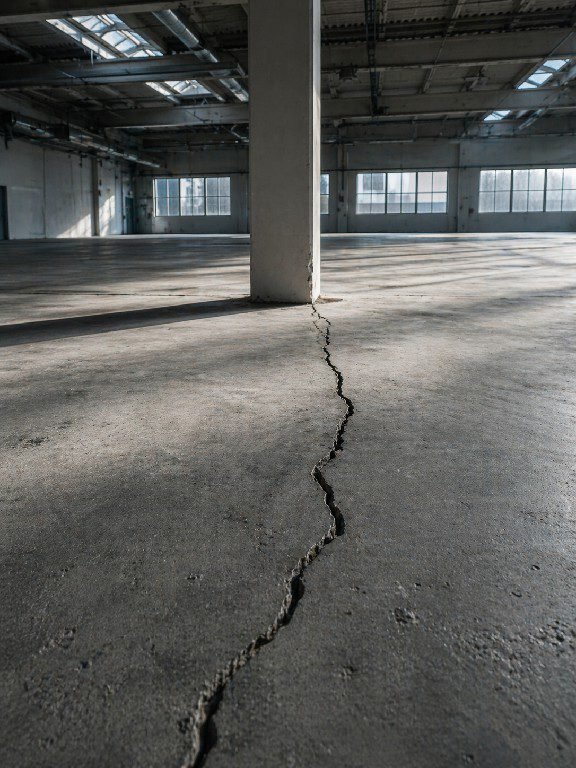
Foundation settlement becomes a problem when it does not stop, when it accelerates, or — most critically — when different parts of the foundation move at different rates. This is called differential settlement, and it is the form responsible for virtually all the structural damage, property value loss, and expensive repair bills associated with the term.
The distinction matters because it changes how you interpret what you see. A building that has descended uniformly by 15 millimetres over five years may show no damage at all — the structure moved as one unit and everything remains aligned. A building where one corner has descended 8 millimetres while another has descended 2 millimetres over the same period will show cracking, distortion, and misalignment — not because of how much it moved, but because of how unevenly it moved.
Building subsidence is a related but distinct concept. Subsidence refers to ground movement that occurs across a wider area — driven by groundwater extraction, underground voids, or soil shrinkage — rather than by the load of the specific structure. In practice, subsidence causes foundation settlement in every building located within the affected zone. The monitoring approach for both is identical: satellite InSAR detects millimetre-scale surface displacement regardless of whether the driver is load-induced consolidation or broader ground movement.
The progression from Stage 1 to Stage 4 does not follow a fixed timeline. In some soil conditions and climates it takes decades. In others — particularly in shrink-swell clay, in areas with active groundwater changes, or in buildings adjacent to major construction activity — it can advance from undetectable to structurally significant within two or three years. What determines where on that timeline a building is discovered is almost entirely a function of whether anyone was measuring.
The Warning Signs — and Why Most Owners Misread Them
The early signals of foundation settlement are consistently misread for one reason: they do not look like foundation problems. They look like isolated maintenance issues. A door that started sticking six months ago gets attributed to humidity or a warped frame. A hairline crack above a window is noted and forgotten. A floor that feels slightly uneven in one room is walked over every day without being measured.
These are not isolated incidents. They are a sequence — and they have a consistent direction of travel. Understanding what each signal actually indicates changes how urgently it is treated.
| Location | Warning Sign | What It Indicates | Urgency |
|---|---|---|---|
| Interior | Doors or windows sticking, not latching, or gaps forming around frames | Frame distortion caused by differential movement in the structure above the foundation | Monitor |
| Diagonal cracks at corners of doors and windows | Classic indicator of uneven foundation movement pulling the structure out of alignment | Assess Soon | |
| Sloping or uneven floors measurable with a level | Foundation has moved measurably beneath the floor slab — movement is typically still active | Act Now | |
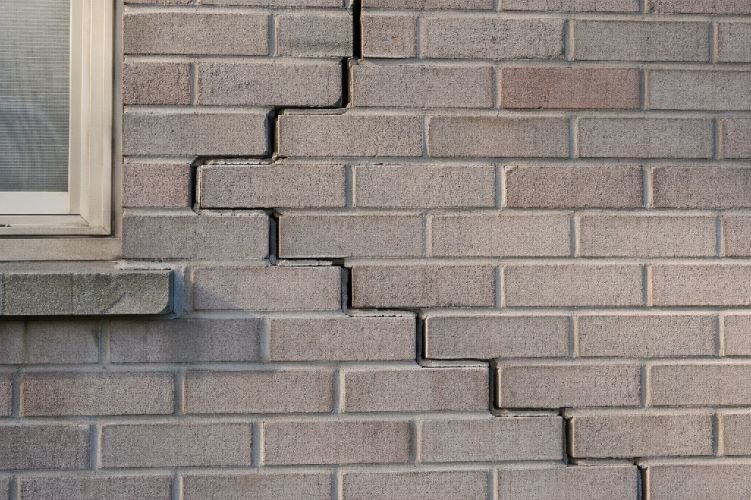
| Exterior | Stair-step cracks in brick or masonry following mortar joints | Differential settlement pulling sections of the structure apart — one of the most definitive external signs | Act Now |
| Visible gap opening between foundation base and surrounding soil | Active downward movement still in progress — soil is no longer providing uniform support | Act Now | |
| Chimney leaning or separating from main structure | Chimneys have independent footings — separation indicates differential movement between zones | Assess Soon | |
| Structural | Horizontal cracks in basement or foundation walls | Lateral soil pressure against the wall — potentially serious and worsening without intervention | Urgent |
| Bowing or bulging foundation or basement walls | Structural integrity at immediate risk — specialist evaluation required without delay | Urgent |
The table above describes what is visible. What it cannot show is the movement that preceded every one of those signs — the period during which the soil was shifting, the foundation was responding, and the repair cost was climbing, silently, with no external signal whatsoever.
What Causes Foundation Settlement — and Which Buildings Are at Higher Risk
Building foundation problems do not arise randomly. They follow patterns tied to soil type, climate, construction quality, and what happens in and around a property over time. Understanding the cause matters because it determines whether a problem is self-limiting or progressive, and whether an intervention addresses the root driver or only the visible symptom.
Soil consolidation under load is the baseline cause of all foundation settlement. Fine-grained soils — clay and silt — compress slowly as pore water drains out under the weight of the structure. In thick clay deposits, this process can continue for years or decades. Properties built on clay-dominant ground carry inherently higher long-term settlement risk, and this risk intensifies with seasonal moisture changes.
Shrink-swell cycles in expansive clay are a major driver of differential settlement across the UK, Australia, and parts of the southern and southwestern United States. During dry periods, clay contracts and pulls away from the foundation unevenly. During wet periods it expands — but not necessarily back to its original geometry. Each cycle applies different stress to different parts of the foundation, and the cumulative effect over years is uneven movement that the original design did not account for.
Adjacent construction activity is one of the least anticipated causes. Excavation for a neighbouring building, tunnelling for metro or utility infrastructure, deep piling work — all of these alter the stress state of the soil over a wide area. Buildings that have been stable for decades can begin moving when a neighbouring project changes groundwater drainage or removes lateral soil support. This category is particularly common in dense urban environments.
Groundwater changes — from drought, from extraction, or from changes in urban drainage — alter the effective stress conditions in the soil beneath a foundation. Many coastal cities and urban centres in arid regions are experiencing measurable land subsidence from long-term groundwater depletion, and every building sitting on that ground is affected whether or not the building itself has any construction defect.
Poor original compaction during construction creates inconsistencies in fill soil that may remain dormant for years — and then manifest as settlement when triggered by the first major drought, heavy rainfall event, or adjacent vibration that disturbs the uncompacted material.
What Foundation Settlement Actually Costs — Three Numbers the SERP Never Puts Together
The financial case for detecting foundation settlement early is not complicated. It is a function of three figures that are almost never presented together, even though all three apply simultaneously to any property with an active settlement problem.
The repair cost escalation. Based on approximate market data from the US — costs vary significantly by country, structure type, and soil conditions — minor foundation interventions addressed at Stage 1 or early Stage 2 typically run in the low thousands. Pier systems, full underpinning, and structural remediation at Stage 3 or 4 are measured in tens of thousands, sometimes significantly more for larger or commercial structures. The movement that costs a modest sum to address at the beginning of its trajectory costs many times more once it has progressed to visible structural damage. This relationship holds across markets, even where absolute figures differ.
The property value impact. Studies from the US real estate market — with similar patterns observed in UK and Australian markets — document value reductions of 10 to 25% for properties with visible foundation problems. For a commercial property worth $500,000, that represents a loss of $50,000 to $125,000. For a residential property, the same percentage applied to any market value produces a loss that dwarfs the cost of early-stage monitoring or repair. Critically, this value reduction crystallises at the point of sale or appraisal — when it can no longer be managed privately.
The transaction cost. In many markets, visible foundation settlement makes properties harder to finance and harder to insure. Mortgage lenders may decline or condition financing on structural reports. Insurers may exclude foundation-related claims or apply significant excesses. Buyers who discover foundation problems during survey frequently withdraw or renegotiate price downward. Each of these outcomes represents a cost — sometimes larger than the repair itself — that is almost entirely avoidable with early detection.
The compounding effect of all three is what makes foundation settlement one of the most financially consequential structural risks a property owner or investor can face. And the single variable that determines which end of the cost range applies is timing.
Three Situations Where SkyIntelGroup Changes the Outcome

Foundation settlement monitoring from SkyIntelGroup is not a single-use service. It applies at different points in the property lifecycle, and the value it delivers depends on which question the client is trying to answer.
Before Purchasing a Commercial Property
A standard structural survey tells a buyer what the building looks like on the day of inspection. It does not reveal whether the foundation has been moving for three years, whether movement has recently accelerated, or whether the soil beneath the property has a documented history of instability. SkyIntelGroup analyses Sentinel-1 satellite radar data going back to 2014 — before a purchase agreement is signed — to produce a deformation history of the specific building footprint. If movement has been occurring, the data shows it: the rate, the pattern, and whether it is consistent with normal consolidation or with an active and potentially worsening problem. For investors acquiring commercial real estate, this is technical due diligence that a visual inspection simply cannot provide.
After a Repair, to Confirm the Problem Is Solved
A significant proportion of foundation settlement repair failures occur not because the repair was technically inadequate, but because the underlying driver of movement — expansive soil, groundwater change, adjacent construction — was still active when the repair was completed. The structure was fixed; the ground continued moving. SkyIntelGroup delivers post-repair monitoring that tracks whether movement has stopped, stabilised, or is resuming — giving property owners the data to confirm their investment held, or to identify a continuing problem before it requires a second round of costly intervention.
Ongoing Monitoring for Building Portfolio Managers
Facility managers and asset managers responsible for multiple properties in areas with documented subsidence risk — coastal cities, clay-soil zones, urban centres with active infrastructure development — need more than periodic inspections. A single inspection is a snapshot. SkyIntelGroup’s satellite monitoring provides a continuously updated baseline across an entire portfolio: which buildings are stable, which are showing early movement, and which warrant a structural engineer’s attention before the problem becomes visible. No site visits required. No sensors to install. Analysis is delivered remotely using satellite data already being acquired.
In all three scenarios the service SkyIntelGroup provides is the same at its core: turning satellite radar data into a deformation history and current movement rate for a specific building — information that changes the decision being made. The full range of Construction-sector monitoring services is on our Construction services page.
How SkyIntelGroup Monitors Foundation Settlement with Satellite Data
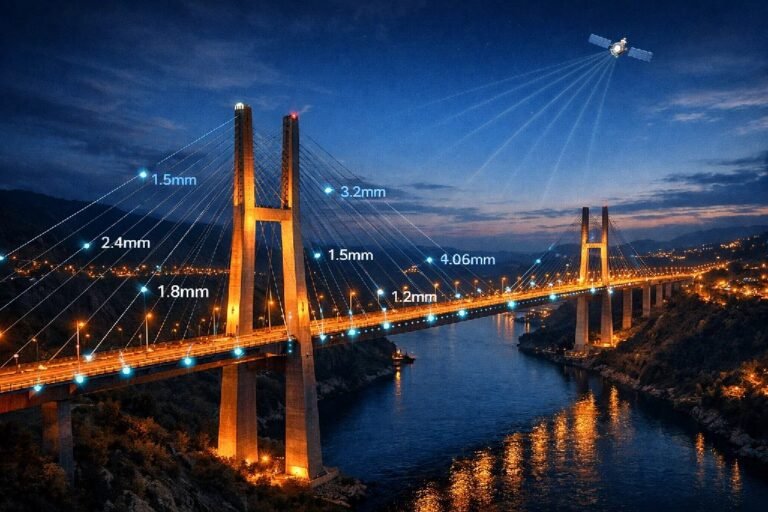
The monitoring method SkyIntelGroup uses — InSAR (Interferometric Synthetic Aperture Radar) — compares radar images of the same location acquired at different dates and detects changes in the distance between the satellite and the surface with millimetre-level precision. Applied to a building and its surrounding ground, it produces a time-series deformation map: which parts of the structure are stable, which are moving, at what rate, and whether that rate is changing.
For building settlement monitoring specifically, this produces four outputs that conventional inspection cannot provide:
A historical deformation baseline from 2014 — not what the building looks like today, but how it has behaved for the past decade. Has it always been stable? Did movement begin two years ago? Did it accelerate after a neighbouring construction project started?
A current movement rate — not just whether the building is settling, but how fast, in which direction, and whether the rate is consistent with previous years or has recently changed. A building settling at a slow and stable rate is a different risk profile from one where the rate has doubled in the past twelve months.
A full footprint coverage map — covering the entire building and surrounding ground, not just the points where physical sensors happen to have been installed. Anomalies that develop in unexpected locations are not missed.
No installation required at the site. No sensors, no access, no disruption to occupants. Analysis is performed on satellite imagery already being acquired — Sentinel-1 passes globally every six days — and delivered remotely. For a more detailed explanation of the technology and its applications across construction projects, see our guide to subsidence monitoring.
| Question the property owner needs answered | Visual Inspection | Point Sensors | Satellite InSAR |
|---|---|---|---|
| Has this building been moving in the last 5 years? | ✗ | ✗ | ✓ |
| Is the current settlement rate accelerating or stable? | ✗ | △ | ✓ |
| Which part of the building footprint is most affected? | △ | △ | ✓ |
| Did movement begin before or after the repair was completed? | ✗ | ✗ | ✓ |
| Is the building currently showing visible structural damage? | ✓ | ✗ | △ |
| Can monitoring be set up without site access or installation? | ✗ | ✗ | ✓ |
Frequently Asked Questions About Foundation Settlement
What is the difference between uniform settlement and differential settlement?
Uniform settlement occurs when an entire structure descends at approximately the same rate across its full footprint. Because the building moves as one unit, structural elements remain aligned, and visible damage is rare even when total settlement is significant. Differential settlement — where different parts of the foundation move at different rates — is what produces cracking, distortion, sticking doors, and sloping floors. The structure is being pulled in competing directions simultaneously. Virtually all the structural damage and property value loss associated with foundation settlement is caused by differential movement, not by total settlement magnitude.
Is foundation settlement covered by property insurance?
Coverage varies significantly by market, insurer, and policy type. In the UK, most standard buildings insurance policies include subsidence as a named peril, with typical excess amounts considerably higher than for other claim types. In the US, standard homeowner’s insurance generally does not cover foundation settlement caused by soil movement — this is typically classified as a maintenance issue rather than a sudden accidental loss. Commercial property policies and specialist structural warranty products vary considerably by jurisdiction. Regardless of insurance coverage, the financial case for early detection is not diminished — uninsured losses from delayed discovery are typically larger than insured ones from early-stage damage.
How do I know if my foundation settlement is still active or has stabilised?
A visual inspection or one-time structural assessment cannot answer this question. It can tell you what the current condition of the building is, but not whether the movement that produced it stopped last year or is still ongoing. This distinction matters enormously for repair decisions: a building where settlement has stabilised may require only cosmetic remediation, while one where movement is still active requires an intervention that addresses the cause before any surface repair will hold. The only way to determine whether settlement is active and at what rate is through time-series deformation data — measurements taken at multiple points in time and compared. Satellite InSAR provides this directly: a time-series of movement across the building footprint showing whether displacement has been consistent, is decelerating, or is accelerating.
Can foundation settlement be detected before visible cracks appear?
Yes — and this is the core value of satellite-based monitoring. The visible signs of foundation settlement appear after the soil has been moving and the structure has been responding for an extended period. Satellite InSAR detects the movement itself, not its consequences. A building whose foundation is descending differentially will show no visible damage in the early stages. That same building, several years later having accumulated significant differential displacement, will show clear structural symptoms. The monitoring window between those two points — during which intervention is straightforward and inexpensive — is only accessible if someone is measuring the movement before it becomes visible.
Is satellite foundation monitoring applicable to residential properties as well as commercial buildings?
Yes. Satellite InSAR analysis works for any permanent structure that produces consistent radar reflections — which includes individual residential dwellings, terraced and semi-detached houses, apartment blocks, and mixed-use buildings, as well as commercial and industrial properties. For residential property owners in areas with documented subsidence risk, the service provides the same historical baseline and current movement rate as for commercial clients. It is equally applicable for pre-purchase due diligence on a residential property, for homeowners tracking settlement after a repair, and for insurers or mortgage lenders assessing structural risk.
What should I do if I notice signs of foundation settlement in my building?
The most important first step is to determine whether the settlement is still active — because this determines whether the visible damage is the full extent of the problem or just the current snapshot of an ongoing process. A structural engineer should be engaged to assess visible damage and recommend repair approaches. In parallel, satellite deformation data for the property can establish how long movement has been occurring, at what rate, and whether it has been accelerating. This combination — structural engineering expertise plus satellite time-series data — gives the most complete picture of what has happened, what is currently happening, and what intervention is most appropriate.
How does adjacent construction affect foundation settlement in neighbouring buildings?
Excavation, tunnelling, and deep piling work change the stress state of soil over a wide radius — often much wider than the construction footprint itself. They can lower the groundwater table temporarily, remove lateral soil support from adjacent ground, or introduce vibration that disturbs previously stable fill soil. Buildings that have been stable for years can begin moving when a neighbouring project starts, and the movement can continue for months after construction is complete as the soil reaches a new equilibrium. Satellite monitoring is particularly valuable in this context because it provides a pre-construction baseline — any subsequent movement in neighbouring buildings can be attributed, timed, and quantified relative to the construction programme, with direct applications for liability assessment.
How far back does the satellite data for my building go?
The European Space Agency’s Sentinel-1 constellation has been acquiring SAR imagery globally since 2014. This means that for virtually any building anywhere in the world, there is a radar data archive going back approximately ten years that can be processed to produce a deformation history. In practice, this means that a property being assessed today can be shown not just its current deformation rate, but the full trajectory of movement since 2014 — whether it was stable until recently and then began moving, whether it has been moving consistently throughout, or whether movement has been cyclical with seasonal patterns. This historical depth is not available from any physical monitoring system that was not already installed during that period.
The Window That Closes — and How to Keep It Open
Foundation settlement is one of the few structural problems where the outcome is almost entirely determined by when it is identified. The soil movement, the structural response, the crack formation — these follow a sequence that does not reverse itself. What changes with early detection is not the existence of the problem, but which stage of that sequence the owner discovers it at, and therefore what the repair cost, the property value impact, and the transaction risk amounts to.
The conventional approach — visual inspection when something looks wrong — places discovery at Stage 2 or 3 almost by definition. The building has to produce a visible signal before the inspection is triggered. Satellite monitoring reverses that sequence. Ten years of archive data plus ongoing acquisition means that for any building, the deformation history is available before the first visible sign appears, and the current rate of movement is measurable in real time.
SkyIntelGroup delivers this analysis globally, without site visits, without installation, and with results derived from data that already exists. Whether the question is about a property being acquired, a repair being verified, or a portfolio being managed for structural risk, the starting point is always the same: what has this building been doing, for how long, and is it still happening now.