Digital Elevation Model in Construction: The Complete Guide to Terrain Data for Site Planning and Design (2026)
Every construction project begins with a fundamental question: what does the terrain actually look like? Without accurate answers, engineers face costly surprises—unexpected drainage problems, miscalculated earthwork volumes, and infrastructure designs that clash with reality. The digital elevation model has become the essential foundation for answering this question with precision.
The global DEM market reflects this critical importance. Industry projections estimate the market will reach between $669.8 million and $1.03 billion in 2025, growing at a compound annual growth rate of 6.4% to 8% through 2033. The Planning and Construction industry represents one of the largest segments driving this expansion, as professionals increasingly recognize that accurate elevation data transforms project outcomes from uncertain to predictable.
Modern terrain analysis capabilities extend far beyond simple topographic visualization. Today’s elevation models enable precise cut and fill calculation, sophisticated flood modeling, optimized infrastructure routing, and data-driven site planning that would have been impossible just a decade ago. Whether you’re evaluating a greenfield development site or planning complex earthwork operations, understanding how to select, acquire, and apply elevation data has become a core competency for construction professionals.
This guide provides a comprehensive examination of digital elevation models in construction contexts. You’ll learn the critical differences between model types, compare data sources from free global datasets to commercial high-resolution products, and discover how leading firms apply elevation intelligence across the project lifecycle.
What Is a Digital Elevation Model? Understanding the Fundamentals
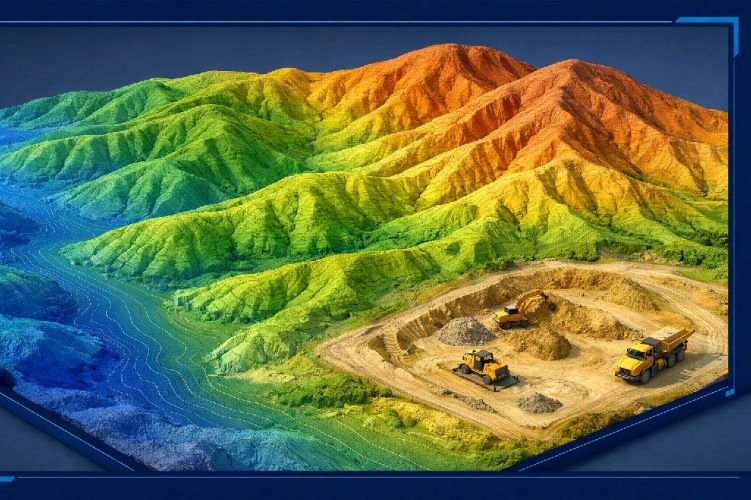
A digital elevation model is a three-dimensional representation of terrain stored as a grid of elevation values. Each cell in this grid contains a single number representing height above a reference datum, typically mean sea level. When millions of these cells are combined, they create a continuous surface that captures the shape of the landscape in digital form.
This gridded structure makes DEMs fundamentally different from traditional contour maps. Rather than representing elevation through lines of equal height, DEMs provide elevation values at regular intervals across the entire area of interest. This format enables computer-based analysis that would be impractical with analog methods—calculating slopes, modeling water flow, and computing volumes become straightforward mathematical operations.
The practical value for construction professionals is immediate. A digital elevation model serves as the geometric foundation for virtually every spatial analysis in modern project delivery. Site suitability assessments, grading plans, drainage designs, and quantity takeoffs all begin with accurate elevation data.
DEM vs DTM vs DSM: Critical Differences Every Engineer Must Know
The terminology surrounding elevation models creates significant confusion, yet understanding these distinctions is essential for selecting the right data for your application. The consequences of using the wrong model type range from minor inefficiencies to fundamental errors in engineering calculations.
| Model Type | What It Represents | Best Applications | Limitations |
|---|---|---|---|
| DEM Digital Elevation Model |
General term covering both bare-earth and surface representations | Umbrella category; specific application depends on whether it’s a DTM or DSM | Ambiguous—always clarify if bare-earth or surface model |
| DTM Digital Terrain Model |
Bare-earth surface only; vegetation and structures removed | Cut/fill calculations, flood modeling, drainage design, infrastructure routing, slope stability | Does not show existing structures; requires more processing to create |
| DSM Digital Surface Model |
First reflective surface including buildings, trees, and infrastructure | Urban planning, 3D city models, telecom tower siting, vegetation management, view obstruction analysis | Cannot be used directly for hydrological modeling or earthwork calculations |
The distinction matters enormously in practice. If you use a digital surface model for flood modeling, the algorithm will incorrectly assume that buildings block water flow, producing fundamentally flawed inundation predictions. Conversely, if you rely solely on a digital terrain model for urban planning, you’ll miss critical information about existing structures and vegetation that affects project feasibility.
Industry guidance is clear on this point: if your project requires precise engineering calculations for construction—particularly earthwork volumes, drainage design, or infrastructure routing—a DTM representing the bare-earth surface is typically the appropriate choice. For visualization, urban context analysis, and telecommunications planning, DSMs provide the necessary surface information.
How Digital Elevation Models Are Created: Data Acquisition Methods
The method used to create a digital elevation model fundamentally determines its accuracy, resolution, and suitability for different applications. Understanding these acquisition technologies helps professionals select appropriate DEM data for their specific project requirements.
Satellite-Based DEM Generation
Satellite platforms generate elevation models through two primary techniques: radar interferometry and optical stereo photogrammetry.
Interferometric Synthetic Aperture Radar (InSAR) measures the phase difference between radar signals bounced off Earth’s surface from slightly different positions. The Shuttle Radar Topography Mission (SRTM) pioneered this approach in 2000, and more recent missions like TanDEM-X have refined the technique to produce the Copernicus DEM with global coverage at 30-meter resolution.
Optical stereo photogrammetry captures overlapping images from different angles, then uses triangulation algorithms to calculate elevation. ASTER GDEM and ALOS World 3D represent major global products created through this approach.
Satellite-based elevation data offers compelling advantages: global coverage, relatively low cost, and the availability of historical archives for change detection. However, typical resolutions of 30 meters limit applicability for detailed engineering design, and neither radar nor optical methods fully penetrate dense vegetation to reveal the true ground surface.
LiDAR and Aerial Survey Methods
Light Detection and Ranging (LiDAR) systems emit laser pulses and measure return times to calculate distances with centimeter-level precision. Airborne LiDAR mounted on aircraft or helicopters can acquire millions of points per second, creating extraordinarily detailed point clouds that capture both the surface and, through vegetation gaps, the underlying terrain.
Drone-based photogrammetry has emerged as a cost-effective alternative for smaller project areas. Unmanned aerial vehicles equipped with high-resolution cameras capture hundreds of overlapping images that software processes into detailed surface models. While drones cannot match LiDAR’s ability to penetrate vegetation, they excel at capturing existing conditions on active construction sites with resolution measured in centimeters.
Both methods produce point clouds that require processing to generate usable surfaces. Ground point classification algorithms separate vegetation and structure returns from bare-earth points, enabling creation of both DTMs and DSMs from the same dataset.
Ground-Based Surveys
Traditional surveying with total stations and RTK GPS provides the highest accuracy but limited coverage. These methods remain essential for establishing control points that validate aerial or satellite data, and for capturing precise elevations at critical locations where millimeter-level accuracy is required.
Modern workflows typically integrate ground surveys with remote sensing data. Control points from GPS surveys improve the absolute accuracy of LiDAR or photogrammetric products, while the broad coverage of aerial methods provides context that ground surveys alone cannot economically capture.
Data Acquisition
Satellite radar, optical stereo, LiDAR, or drone imagery captures raw elevation information
Point Cloud Processing
Classification algorithms separate ground points from vegetation and structures
Surface Interpolation
Algorithms create continuous gridded surfaces from discrete point measurements
Quality Validation
Ground control points and statistical analysis verify accuracy meets requirements
Free vs Commercial DEM Data Sources: A Practical Comparison
The availability of free global DEM data has expanded dramatically, yet significant differences in accuracy and resolution determine which sources are appropriate for specific construction applications. Understanding these tradeoffs enables professionals to optimize data acquisition budgets while meeting project requirements.
| Data Source | Resolution | Coverage | Vertical Accuracy (RMSE) | Cost | Best For |
|---|---|---|---|---|---|
| Copernicus DEM | 30m / 90m | Global | <4m | Free | Regional planning, feasibility screening |
| NASADEM | 30m | Global (56°S–60°N) | ~3m | Free | Improved SRTM for hydrological modeling |
| ALOS World 3D | 30m / 5m | Global | ~5m (30m) / <2m (5m) | Free / Commercial | Balance of resolution and global coverage |
| SRTM | 30m | Global (56°S–60°N) | ~6m | Free | Legacy projects, historical baseline |
| ASTER GDEM | 30m | Global | ~8.5m | Free | Supplementary coverage, void filling |
| USGS 3DEP / S1M | 1m | USA (expanding) | <0.5m | Free | US projects requiring high-resolution bare-earth |
| Satellite Stereo (Maxar, Pléiades) | 0.5–2m | On-demand tasking | 1–3m | $$–$$$ | Custom high-resolution for specific sites |
| Airborne LiDAR | 0.5–2m | Project-specific | 0.1–0.5m | $$$$ | Precision earthwork, detailed engineering design |
The Copernicus DEM has emerged as the new standard for free global elevation data. Based on TanDEM-X radar data with more than 99% of coverage coming from a single consistent source, it offers superior accuracy and seamless coverage compared to older alternatives. Validation studies comparing Copernicus DEM against ground truth consistently show vertical RMSE below 4 meters, outperforming both SRTM and ASTER across most terrain types.
For projects in the United States, the USGS 3D Elevation Program represents a transformative resource. Production of the Seamless 1-Meter DEM (S1M) began in 2025, delivering LiDAR-derived bare-earth elevation with sub-meter accuracy. Unlike previous products published as individual projects, S1M integrates datasets across project boundaries with standardized projection and vertical datum, eliminating complex preprocessing that previously consumed significant project time.
The decision between free and commercial data depends primarily on accuracy requirements. Regional feasibility assessments and preliminary planning typically succeed with 30-meter global products. Detailed engineering design, precise earthwork volume calculations, and regulatory compliance often require the centimeter-level accuracy that only LiDAR can provide.
Construction Applications: How DEMs Transform Project Delivery
The practical value of digital elevation model data extends across the entire construction project lifecycle. From initial site selection through final as-built documentation, accurate terrain analysis capabilities reduce costs, minimize risks, and accelerate decision-making.
Site Planning and Feasibility Studies
Before any design work begins, developers and engineers must understand the topographic constraints and opportunities of potential sites. Elevation data enables rapid assessment of slopes, drainage patterns, and accessibility that determine fundamental project feasibility.
Slope analysis identifies areas that may require extensive grading, retaining structures, or alternative design approaches. Aspect calculations reveal solar exposure patterns relevant to building orientation and energy performance. Drainage pattern analysis highlights natural flow paths that site planning should accommodate rather than fight against.
The efficiency gains from remote analysis are substantial. Research has documented exploration cost reductions of up to 90% when satellite-derived elevation data guides field investigation efforts, allowing teams to focus expensive ground-truthing on areas identified as most promising through desktop analysis.
Earthwork and Cut-Fill Volume Calculations
Accurate cut and fill calculation represents one of the highest-value applications of digital elevation model data in construction. The fundamental concept is straightforward: compare existing terrain elevations against proposed design grades, then calculate the volumes of material that must be excavated (cut) or placed (fill) to achieve the design surface.
Three primary methods exist for calculating earthwork volume from elevation data. The Grid Method divides terrain into uniform cells and compares average existing and proposed elevations for each cell. The Cross-Section Method creates vertical slices through the site at regular intervals and calculates areas of cut and fill for each section. The Triangular Prism Method, used by most modern software, creates triangulated irregular networks (TINs) that preserve terrain detail more accurately than grid-based approaches.
The quality of input DEM data directly determines output reliability. When base surface accuracy is poor, even sophisticated calculation algorithms produce unreliable results. For projects where earthwork costs represent significant budget items, investing in high-resolution LiDAR or drone-derived elevation data typically pays for itself through more accurate quantity estimation and reduced change orders during construction.
Modern earthwork software platforms including Autodesk Civil 3D, Trimble Business Center, and AI-powered tools like TestFit integrate digital elevation model data directly into design workflows. These systems generate not only volume calculations but also visualization of cut and fill zones, haul optimization analysis, and progress monitoring capabilities that track actual earthwork against planned quantities.
Flood Risk Assessment and Drainage Design
Water flows downhill following paths determined by terrain geometry. Accurate digital terrain model data enables precise prediction of these flow paths, supporting both flood modeling for risk assessment and drainage system design that works with natural hydrology rather than against it.
The Height Above Nearest Drainage (HAND) index, derived from DTM analysis, provides a computationally efficient method for identifying flood-prone areas. By calculating each point’s elevation relative to the nearest stream channel, HAND maps highlight low-lying areas most vulnerable to inundation without requiring complex hydraulic modeling.
For detailed flood risk analysis, DTMs integrate with hydraulic modeling software including HEC-RAS, LISFLOOD-FP, and similar platforms. These models simulate water surface elevations and flow velocities under various storm scenarios, producing inundation maps that inform both site design and emergency planning. Research has demonstrated that flood modeling accuracy depends heavily on DEM quality, with high-resolution LiDAR-derived DTMs significantly outperforming coarser satellite products in urban environments where small elevation differences determine whether structures flood.
Drainage design applies similar principles at the site scale. Existing terrain analysis identifies natural drainage patterns and accumulation areas that proposed grading should accommodate. Design optimization balances cut-fill volumes against hydraulic performance, seeking solutions that minimize earthwork while ensuring adequate drainage capacity and appropriate outlet locations.
Infrastructure Routing and Slope Analysis
Linear infrastructure including roads, railways, pipelines, and transmission lines requires careful route optimization that balances construction cost, operational performance, and environmental impact. Terrain analysis using digital elevation model data enables systematic evaluation of route alternatives against multiple criteria.
Slope constraints directly affect construction feasibility and cost. Roads and railways have maximum grade specifications that terrain must accommodate, either through alignment that follows natural contours or through cuts, fills, and structures that modify the terrain. Pipeline routes must consider not only slope but also potential for ground movement that could stress buried infrastructure over time.
Optimized routing using DEM-based analysis minimizes earthwork quantities while meeting design standards. Algorithms evaluate thousands of potential alignments, calculating cut-fill volumes and identifying locations where structures may be required. The result is designs that achieve project objectives at lower cost than routes selected through less rigorous methods.
Need Accurate Elevation Data for Your Construction Project?
Our satellite-based DEM generation services deliver precision terrain models for site planning, earthwork calculations, and infrastructure design. From feasibility screening to detailed engineering, we provide the elevation intelligence your project requires.
Choosing the Right DEM for Your Construction Project
Selecting appropriate elevation data requires matching data characteristics to project requirements. Resolution, accuracy, temporal currency, and model type all influence whether a particular dataset will meet your needs.
Resolution Requirements by Project Type
Resolution determines the size of terrain features that can be represented. A 30-meter digital elevation model cannot capture a 10-meter-wide drainage channel; it simply averages the channel with surrounding terrain. Matching resolution to the scale of features relevant to your project is essential.
Regional feasibility assessments and preliminary site planning typically succeed with 30-meter global products like Copernicus DEM or NASADEM. At this scale, the goal is understanding general topographic patterns—major slope directions, approximate drainage basins, and overall terrain character—rather than precise engineering measurements.
Detailed design requires finer resolution. Infrastructure routing, grading design, and drainage engineering typically need 1 to 5-meter data to capture terrain features that affect construction costs and design performance. For most construction sites outside areas with existing high-resolution public data, this means commissioning satellite stereo or aerial survey acquisition.
Precision earthwork and as-built verification demand the highest resolution. When cut and fill calculation accuracy directly affects payment quantities or when millimeter-level monitoring is required, only LiDAR with sub-meter resolution provides adequate precision.
Accuracy Considerations
Resolution and accuracy are distinct characteristics. A high-resolution model with poor accuracy provides false precision—detailed data that doesn’t match reality. Root Mean Square Error (RMSE) quantifies vertical accuracy by measuring the typical difference between DEM elevations and ground truth measurements.
Terrain type and land cover significantly affect accuracy. Validation studies consistently show that all DEM data sources perform better in flat, bare terrain than in steep, vegetated areas. Forest canopy blocks optical sensors and scatters radar returns, while steep slopes introduce geometric distortions. When selecting data for challenging terrain, accuracy specifications should be verified for conditions similar to your project site.
Temporal Currency: Why Data Age Matters
SRTM data captures terrain conditions from February 2000. Copernicus DEM reflects 2020 conditions. For sites that have changed significantly—through construction, mining, erosion, or other processes—historical elevation data may not represent current reality.
Multitemporal DEM comparison enables change detection, tracking elevation differences over time to identify areas of subsidence, erosion, or accumulation. Construction progress monitoring applies this concept to verify earthwork quantities by comparing sequential surveys against design surfaces.
For active construction sites requiring current conditions, fresh data acquisition is typically necessary. The decision between satellite tasking, drone survey, or LiDAR depends on accuracy requirements, site accessibility, and budget constraints.
DEM Selection Decision Guide
✓ Use Free Global DEMs When:
- Regional feasibility screening
- Preliminary site selection
- Large-area drainage basin analysis
- Desktop reconnaissance studies
- Budget constraints preclude custom acquisition
✓ Use Commercial High-Res When:
- Detailed engineering design required
- Earthwork quantities drive project economics
- Regulatory compliance demands precision
- Infrastructure routing optimization
- Current-condition data essential
✓ Use LiDAR When:
- Centimeter-level accuracy required
- Dense vegetation covers the site
- Payment quantities based on surveys
- Complex terrain with fine features
- Flood modeling in urban environments
✓ Model Type Selection:
- DTM: Earthwork, flood modeling, drainage
- DSM: Urban planning, telecom, 3D visualization
- Both: Calculate vegetation/building heights
- When uncertain, ask: «Do I need bare earth or full surface?»
The Future of Elevation Data in Construction
The trajectory of digital elevation model technology points toward greater accessibility, higher resolution, and tighter integration with construction workflows.
Artificial intelligence and machine learning increasingly automate DEM processing and analysis. Algorithms that once required specialist expertise now run automatically, classifying point clouds, detecting anomalies, and generating analysis-ready surfaces with minimal human intervention. These capabilities lower barriers to adoption while improving consistency across projects.
Digital twin integration represents a significant evolution in how elevation data connects to broader project information systems. Rather than treating DEMs as standalone datasets, digital twin platforms incorporate terrain alongside BIM models, scheduling data, and sensor feeds to create comprehensive virtual representations of physical assets. This integration enables simulation and analysis that considers terrain context throughout the project lifecycle.
Constellation architectures deploying large numbers of small satellites promise more frequent revisits and faster data delivery. Where traditional satellites might image a location weekly or monthly, emerging constellations aim for daily or even intraday coverage. For construction monitoring applications, this frequency enables near-real-time progress tracking that current systems cannot support.
Cloud-based platforms increasingly offer on-demand access to elevation data and processing capabilities. Rather than downloading massive datasets and running analysis locally, users can query cloud archives, specify processing parameters, and receive results without managing data infrastructure. This model reduces barriers for organizations that lack dedicated geospatial expertise while enabling access to computing resources that would be impractical to maintain internally.
Frequently Asked Questions
What is the difference between DEM, DTM, and DSM?
A digital elevation model is a general term covering any gridded elevation dataset. A digital terrain model specifically represents the bare-earth surface with vegetation and structures removed, making it appropriate for earthwork calculations, drainage analysis, and flood modeling. A digital surface model captures the first reflective surface including buildings and trees, suited for urban planning, telecommunications, and 3D visualization. The key question when selecting data is whether you need bare-earth elevations or full surface representation.
What resolution DEM do I need for construction site planning?
Resolution requirements depend on project phase and application. Regional feasibility screening typically succeeds with 30-meter global products like Copernicus DEM. Detailed engineering design usually requires 1 to 5-meter data from satellite stereo or aerial survey. Precision earthwork where payment quantities depend on survey accuracy demands sub-meter LiDAR. Matching resolution to the scale of relevant terrain features ensures adequate detail without unnecessary data volume.
Are free DEMs accurate enough for engineering projects?
Free global DEMs including Copernicus DEM, NASADEM, and ALOS World 3D provide sufficient accuracy for preliminary planning, regional analysis, and feasibility screening. Vertical RMSE values ranging from 3 to 8 meters make these products appropriate for understanding general terrain character but inadequate for detailed design or quantity calculation. Engineering projects requiring precision measurements typically need commercial high-resolution data or LiDAR with documented accuracy meeting project specifications.
How often should I update my DEM data?
Update frequency depends on site activity and application requirements. Stable sites with no construction or natural change may use the same elevation data for years. Active construction sites often require monthly or more frequent surveys to track progress and verify quantities. Monitoring applications may establish baseline conditions then acquire new data at intervals appropriate to expected change rates. For any project where current conditions matter, verify that data currency meets your needs before proceeding with analysis.
Can satellite DEMs detect small elevation changes?
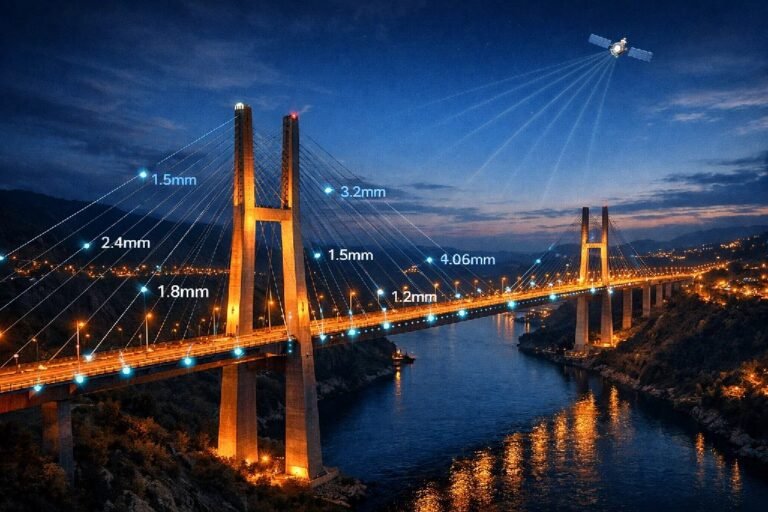
Standard satellite-derived DEMs cannot reliably detect changes smaller than their vertical accuracy—typically several meters for global products. However, InSAR techniques analyzing phase differences between radar acquisitions can detect millimeter-scale surface displacement over time. This capability enables ground deformation monitoring for subsidence, landslides, and structural settlement, though it requires specialized processing and is distinct from conventional DEM analysis.
Conclusion
The digital elevation model has become foundational infrastructure for modern construction practice. From initial site planning through earthwork execution and final documentation, accurate elevation data enables decisions based on terrain reality rather than assumption.
Understanding the distinctions between digital terrain model and digital surface model products ensures appropriate data selection for each application. Matching resolution and accuracy requirements to project needs optimizes data acquisition investments. Recognizing when free global datasets suffice and when commercial high-resolution data is necessary prevents both unnecessary expense and inadequate precision.
The applications examined here—feasibility analysis, cut and fill calculation, flood modeling, and infrastructure routing—represent current standard practice. Emerging capabilities in AI-assisted processing, digital twin integration, and cloud-based platforms will extend these applications while making sophisticated terrain analysis accessible to broader audiences.
For construction professionals, the practical imperative is clear: elevation intelligence reduces risk, improves cost estimation accuracy, and supports design decisions that work with terrain rather than fighting against it. The investment in appropriate DEM data pays dividends throughout the project lifecycle.
Transform Your Construction Planning with Satellite-Derived Elevation Data
From site feasibility assessment to earthwork optimization, our DEM generation services deliver the terrain intelligence your projects require. Get accurate elevation models customized to your resolution and accuracy specifications.