Leak Detection Services: How to Choose the Right Technology for Your Pipeline Network
The oil and gas industry spends more than $3 billion annually on leak detection services, yet small leaks continue to go undetected for days or even weeks. Meanwhile, pipeline operators face a mounting challenge: aging infrastructure, stricter regulatory requirements, and growing environmental liability that can cost millions in fines, remediation, and reputational damage.
Choosing the right leak detection technology has never been more critical. The Pipeline and Hazardous Materials Safety Administration (PHMSA) finalized sweeping new requirements in January 2025, mandating advanced leak detection programs across the nation’s 2.8 million miles of gas pipelines. And in July 2025, PHMSA officially approved satellite and unmanned aerial systems for right-of-way patrols, opening new possibilities for operators seeking cost-effective, wide-area monitoring solutions.
This guide walks you through the available pipeline leak detection system technologies, compares their strengths and limitations, and provides a practical framework for selecting the right approach for your network. Whether you operate liquid transmission lines, gas gathering systems, or offshore pipelines, the goal is the same: detect leaks faster, locate them accurately, and respond before small problems become catastrophic events.
At Sky Intel Group, we provide satellite pipeline monitoring services that complement traditional detection methods, delivering wide-area coverage without physical installation. Our approach fills the gaps that conventional systems miss, particularly in remote terrain and along extended pipeline corridors.
Why Leak Detection Services Matter More Than Ever in 2026
The True Cost of Pipeline Leaks: Financial, Environmental, and Reputational
Pipeline leaks carry consequences that extend far beyond the immediate repair. Globally, oil and gas companies spend approximately $17 billion annually on pipeline repairs alone, and that figure does not include environmental remediation costs, regulatory fines, or legal settlements.
The financial exposure continues to grow. A single significant leak can trigger cleanup costs measured in tens of millions of dollars, particularly when groundwater contamination or sensitive ecosystems are involved. Beyond direct costs, companies face operational shutdowns, lost production revenue, and supply disruption penalties.
Environmental liability has intensified as governments worldwide tighten regulations and enforcement. The United States, European Union, Canada, and Australia have all strengthened pipeline safety requirements in recent years, with substantial penalties for non-compliance. In the U.S., PHMSA can impose civil penalties exceeding $200,000 per violation per day, with no maximum limit for a series of violations.
Perhaps most significant is the reputational damage. Public trust in pipeline operators erodes with each high-profile incident, threatening the social license to operate that companies depend upon for route approvals, permit renewals, and community relations. In 2023, the United States recorded its deadliest year for natural gas pipeline failures in over a decade, underscoring that current detection capabilities still leave dangerous gaps.
PHMSA 2025 Regulations: What Pipeline Operators Must Know
The regulatory landscape shifted dramatically in January 2025 when PHMSA issued its Final Rule on Gas Pipeline Leak Detection and Repair. This rule implements congressional mandates from the PIPES Act of 2020 and represents the most significant update to leak detection requirements in decades.
The rule applies to gas transmission lines, distribution pipelines, regulated gathering lines, underground natural gas storage facilities, and LNG facilities. Key requirements include establishing advanced leak detection programs, increasing survey frequencies, implementing leak grading and repair criteria with mandatory timelines, and using commercially available detection technologies.
PHMSA estimates the rule will deliver up to $1.5 billion in annual net benefits to the public while eliminating up to 500,000 metric tons of methane emissions from covered facilities. Operators must invest in new technologies, update maintenance procedures, and train personnel to meet qualification standards.
A critical development came in July 2025 when PHMSA issued a Direct Final Rule clarifying that satellite pipeline monitoring and unmanned aerial systems satisfy right-of-way patrol requirements under §192.705 and §195.412. The rule explicitly states that patrol methods include «imaging via satellite» alongside traditional walking, driving, or flying via manned aircraft. This regulatory clarity has accelerated adoption of remote sensing technologies across the industry.
Understanding Leak Detection Technologies: A Complete Comparison
Internal vs. External Leak Detection Methods
Leak detection technology falls into two broad categories: internal methods that analyze what happens inside the pipeline, and external methods that monitor conditions outside or around it.
Internal methods, often called Computational Pipeline Monitoring (CPM) systems, use instrumentation already installed on the pipeline to detect anomalies. These include pressure monitoring, flow balance calculations, Real-Time Transient Models (RTTM), and statistical analysis techniques. They work by comparing measured values against expected values and flagging discrepancies that may indicate a leak.
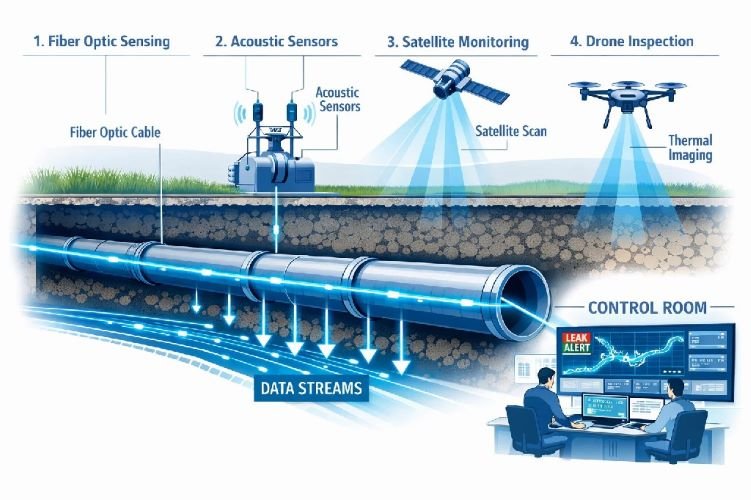
External methods monitor the pipeline environment using sensors or surveillance positioned outside the pipe itself. This category includes fiber optic sensing cables, acoustic sensors, vapor detection tubes, thermal cameras, satellite imagery, and visual inspection via patrol or drone.
Industry standards from the American Petroleum Institute, particularly API 1130 for liquid pipelines and API 1160 for managing system integrity, recommend combining internal and external approaches. Shell’s Design Engineering Practice (DEP 31.40.00) similarly advises that multiple methods improve both detection threshold and location accuracy. No single technology excels in every situation, which is why the most effective programs layer complementary systems.
Hardware-Based Systems: Fiber Optic, Acoustic, and Pressure Sensors
Fiber optic pipeline monitoring has emerged as one of the most capable hardware-based solutions. Distributed Acoustic Sensing (DAS), Distributed Temperature Sensing (DTS), and Distributed Strain Sensing (DSS) systems use fiber optic cables installed along the pipeline length as continuous sensors. When a leak occurs, it creates temperature changes, acoustic signatures, or strain variations that propagate through the fiber and can be detected with location accuracy within 3 meters.
The advantages are substantial: continuous coverage across the entire instrumented length, real-time detection, and the ability to identify third-party intrusion and ground movement in addition to leaks. However, installation costs are high, particularly for buried pipelines. Retrofitting fiber on existing operational pipelines is often impractical due to the excavation required and service interruption involved.
Acoustic sensors detect the sound waves generated when fluid or gas escapes through a breach. They work well for sudden ruptures that create strong acoustic signatures but may miss slow seepage. Range is limited, so multiple sensors are needed for comprehensive coverage.
Pressure and flow monitoring remains the baseline approach for most pipelines. Sensors at key points track pressure drops and flow imbalances that indicate a leak. While cost-effective and already in place on most instrumented pipelines, these systems struggle to detect small leaks below approximately 1% of flow rate and cannot pinpoint location with precision.
Software-Based Systems: RTTM, CPM, and AI-Driven Analytics
Software-based detection systems analyze data from pipeline instrumentation using computational models. The Real-Time Transient Model (RTTM) approach simulates the hydraulic behavior of the pipeline and compares predicted conditions against actual sensor readings. Discrepancies suggest anomalies that may be leaks.
RTTM systems require accurate pipeline geometry data, fluid properties, and well-calibrated instrumentation. When properly tuned, they can detect relatively small leaks and provide estimated location. However, they are sensitive to transient conditions like startup, shutdown, and batch changes, which can generate false alarms.
Compensated Volume Balance (CVB) and statistical methods offer another software approach, comparing inflow and outflow while accounting for known factors like temperature effects and measurement uncertainty. These systems trade some sensitivity for reduced false alarm rates.
Machine learning and AI-driven analytics represent the newest evolution. By training algorithms on historical operational data, these systems learn to recognize patterns associated with normal operation and flag anomalies that deviate from expected behavior. They can adapt over time and potentially catch subtle leak signatures that rule-based systems miss. A PHMSA-funded study found that legacy mass-balance systems generated false alarms approximately 1.47% of the time, a rate that advanced analytics aim to reduce.
Satellite and Remote Sensing: The Emerging Technology Now Approved by PHMSA
Satellite pipeline monitoring has transitioned from experimental to operationally accepted. The July 2025 PHMSA ruling that explicitly includes satellite imaging as a compliant patrol method removed regulatory uncertainty that had slowed adoption.
Hyperspectral satellite sensors capture hundreds of spectral bands across the electromagnetic spectrum, far beyond what the human eye can see. This allows identification of specific materials based on their unique spectral signatures. Methane gas absorbs light at characteristic wavelengths around 1.65 and 2.3 micrometers in the shortwave infrared range. Hydrocarbon liquids similarly leave detectable spectral fingerprints when they reach the surface or affect surrounding vegetation.
The GHOSt constellation from Orbital Sidekick, for example, uses hyperspectral sensors capturing 472 bands of light and currently monitors over 124,000 miles of pipeline infrastructure. These satellites can survey transcontinental pipeline networks in hours rather than the weeks required for ground-based inspection.
Remote sensing pipeline monitoring also leverages Synthetic Aperture Radar (SAR) technology. SAR works through clouds, smoke, and darkness, providing all-weather monitoring capability. Differential InSAR (DInSAR) can detect millimeter-scale ground displacement, identifying subsidence or ground movement that may stress pipelines before failures occur.
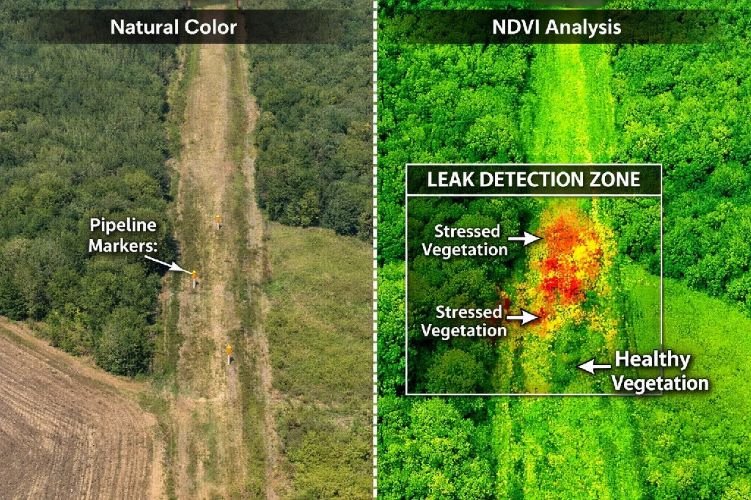
Multispectral analysis using vegetation indices like NDVI (Normalized Difference Vegetation Index) offers another detection pathway. When hydrocarbons leak from a buried pipeline, they affect soil chemistry and stress the root systems of plants above. This vegetation stress appears in satellite imagery as altered spectral reflectance days or even weeks before the leak becomes visible at the surface. Studies have demonstrated that satellite vegetation analysis can identify leaks five days earlier than traditional patrol methods.
How to Evaluate Leak Detection Services for Your Pipeline Network
Key Performance Criteria: Sensitivity, Accuracy, and Response Time
When comparing oil and gas leak detection technologies, four performance metrics matter most: detection sensitivity, location accuracy, response time, and false alarm rate.
Detection sensitivity refers to the smallest leak a system can reliably identify. Pressure-based methods typically require leaks exceeding 1% of flow rate to trigger alarms. Fiber optic systems can detect much smaller anomalies based on temperature or acoustic signatures. Satellite hyperspectral sensing depends on spectral signal strength but can identify emissions and affected vegetation across wide areas.
Location accuracy determines how precisely the system can pinpoint a leak. Fiber optic DAS can localize events within 3 meters along the instrumented cable. Software-based CPM systems provide estimated ranges that may span several kilometers. Satellite imagery resolution varies by sensor but modern high-resolution optical satellites achieve sub-meter precision for surface-visible indicators.
Response time encompasses how quickly the system detects an anomaly after it begins and how rapidly that information reaches decision-makers. Fiber optic and SCADA-integrated systems provide near-real-time detection. Satellite detection timing depends on orbital revisit frequency, though constellation designs are improving this rapidly.
False alarm rate significantly impacts operational efficiency. Each false positive triggers crew mobilization, investigation, potential shutdown, and documentation effort. Systems with high false alarm rates erode operator confidence and may lead to delayed response when real leaks occur.
Operational Considerations: Retrofitting, Maintenance, and Integration
The practical challenges of implementing leak detection services often determine what technology is feasible for a given pipeline.
For new construction, the full range of options is available. Fiber optic cables can be installed alongside the pipeline during burial, and instrumentation can be designed into pump stations and valve sites from the start. Costs are manageable when incorporated into initial capital expenditure.
Existing pipelines present a different challenge. Retrofitting fiber optic systems on buried, operational pipelines requires excavation, service interruption, and substantial expense. For pipelines that have operated for decades without continuous monitoring, non-invasive approaches become more attractive.
This is where satellite pipeline monitoring offers a distinct advantage: no physical installation is required. Operators can begin monitoring existing pipelines immediately using archived and newly acquired satellite imagery without modifying the infrastructure or interrupting operations.
Maintenance demands vary by technology. Sensors require periodic calibration, batteries need replacement, and software needs updates. Fiber optic systems are relatively maintenance-free once installed, but any cable damage requires repair. Satellite-based services shift maintenance responsibility to the provider, reducing operator burden.
Integration with existing control systems matters for operational efficiency. Leak detection data is most valuable when it flows into SCADA systems and GIS platforms that operators already use. API standards and common data formats facilitate this integration, but compatibility should be verified before procurement.
Matching Technology to Pipeline Type: Liquid, Gas, Offshore, and Remote Terrain
Different pipeline configurations and operating environments favor different detection approaches.
Liquid pipelines transporting crude oil, refined products, or hazardous liquids generally work well with RTTM and fiber optic systems. The incompressibility of liquids makes pressure-based detection more effective than in gas pipelines. Hydrocarbon liquids also leave visible surface expressions and affect vegetation when they leak, making aerial and satellite surveillance effective.
Gas pipelines present greater challenges for traditional methods. Gas compressibility means pressure changes propagate slowly and may not clearly indicate small leaks. Acoustic methods can detect gas escaping under pressure. Hyperspectral satellite sensors designed for methane leak detection offer particular value here, identifying emissions based on the gas’s spectral signature.
Offshore pipelines operate in environments where most monitoring options are limited. Subsea segments are difficult to instrument with external sensors after installation. Fiber optic systems must be incorporated during construction. Satellite surveillance can monitor platform facilities, detect surface oil sheens, and track vessel activity in pipeline corridors. Flow metering at platform connections remains a primary method for subsea leak indication.
Remote and inaccessible terrain poses logistical challenges for any technology requiring physical presence. Mountain crossings, arctic regions, desert expanses, and jungle corridors make ground patrol expensive and infrequent. Helicopter patrols are costly and weather-dependent. Satellite and UAV surveillance become the practical choices for comprehensive coverage in these environments, providing data regardless of ground accessibility.
| Technology | Liquid Pipelines | Gas Pipelines | Offshore | Remote Terrain | Retrofitting |
|---|---|---|---|---|---|
| Fiber Optic DAS/DTS | ✅ Excellent | ✅ Good | ⚠️ Limited | ⚠️ Costly | ❌ Difficult |
| RTTM/CPM Software | ✅ Excellent | ⚠️ Limited | ✅ Good | ✅ Good | ✅ Easy |
| Acoustic Sensors | ✅ Good | ✅ Good | ❌ Not suitable | ⚠️ Limited | ⚠️ Moderate |
| Satellite Remote Sensing | ✅ Good | ✅ Excellent | ✅ Excellent | ✅ Excellent | ✅ No installation |
| UAV/Drone Inspection | ✅ Good | ✅ Good | ⚠️ Limited | ✅ Excellent | ✅ Easy |
The Role of Satellite Intelligence in Modern Leak Detection Programs
Why PHMSA Now Accepts Satellite Monitoring for Compliance
The July 2025 PHMSA Direct Final Rule marked a turning point for satellite pipeline monitoring adoption. By explicitly stating that «imaging via satellite» satisfies right-of-way patrol requirements, the agency removed regulatory ambiguity that had caused operators to hesitate.
The rule reflects a technology-neutral approach to pipeline safety. PHMSA recognized that satellite and UAS patrols often provide better coverage at lower cost than traditional methods. Satellite surveys are less expensive than helicopter patrols, create no noise impacts on communities, generate no local emissions, and pose no risk to pilot safety.
Industry associations including the American Petroleum Institute and the Liquid Energy Pipeline Association actively advocated for this regulatory clarity, noting that interpretation letters had already confirmed satellite eligibility but explicit regulation would accelerate adoption. The rule requires that satellite imagery provide «current information and imaging quality comparable to traditional aerial patrols,» a standard that modern Earth observation satellites readily meet.
For operators, this means satellite monitoring can now be formally incorporated into compliance programs for the mandated patrols at intervals not exceeding three weeks. Many are finding that satellite surveillance actually exceeds traditional patrol capabilities by capturing data across the entire corridor rather than relying on visual observation from an aircraft.
How Satellite Leak Detection Works: From Hyperspectral to NDVI Analysis
Several satellite technologies contribute to pipeline monitoring solutions, each detecting different leak indicators.
Hyperspectral sensors capture light across hundreds of narrow spectral bands, creating a detailed spectral fingerprint of everything in the image. Methane gas has characteristic absorption features in the shortwave infrared range that hyperspectral sensors can identify. Liquid hydrocarbons similarly produce identifiable spectral signatures when they contaminate soil or water. This allows detection of both gas leaks and liquid product releases.
Thermal infrared imaging detects temperature differences. Escaping fluids may have different temperatures than surrounding soil, and evaporating liquids can create cooling signatures. Thermal sensors work day and night but require sufficient temperature contrast between the leak and environment.
Multispectral imaging with fewer, broader bands supports vegetation analysis through indices like NDVI. Healthy vegetation reflects strongly in near-infrared wavelengths while absorbing red light for photosynthesis. Stressed or dying plants show reduced near-infrared reflectance. When hydrocarbons from a subsurface leak affect plant roots, the resulting stress appears in satellite-derived NDVI values. This technique has proven capable of identifying leaks days before surface expression or pressure anomalies, providing early warning that prevents larger releases.
Synthetic Aperture Radar uses microwave energy to image the ground regardless of weather or lighting. Differential InSAR compares radar images from different times to measure ground surface displacement with millimeter precision. This can identify subsidence, ground heave, or slope movement along pipeline corridors that may indicate integrity threats even before leaks occur.
Change detection algorithms compare current imagery against historical baselines to identify new activities or alterations in pipeline corridors. This is particularly valuable for detecting ROW encroachment detection where unauthorized construction, excavation, or vehicle activity threatens pipeline safety. Since third-party interference causes approximately 80% of pipeline failures, early identification of encroachment activity can prevent leaks before they happen.
Satellite as a Complementary Layer: Filling the Gaps in Traditional Systems
The greatest value of satellite surveillance comes from its role as a complementary layer within a multi-technology detection program. It does not replace SCADA monitoring, fiber optic sensing, or inspection pigging, but it addresses gaps that those systems cannot fill.
Traditional point sensors, whether pressure gauges, flow meters, or acoustic devices, monitor specific locations. Between those points lie coverage gaps where events can occur undetected. A leak midway between sensors may not generate sufficient signal at either location to trigger an alarm. Distributed fiber optic sensing eliminates gaps along instrumented sections but does not cover the many pipelines where fiber was never installed.
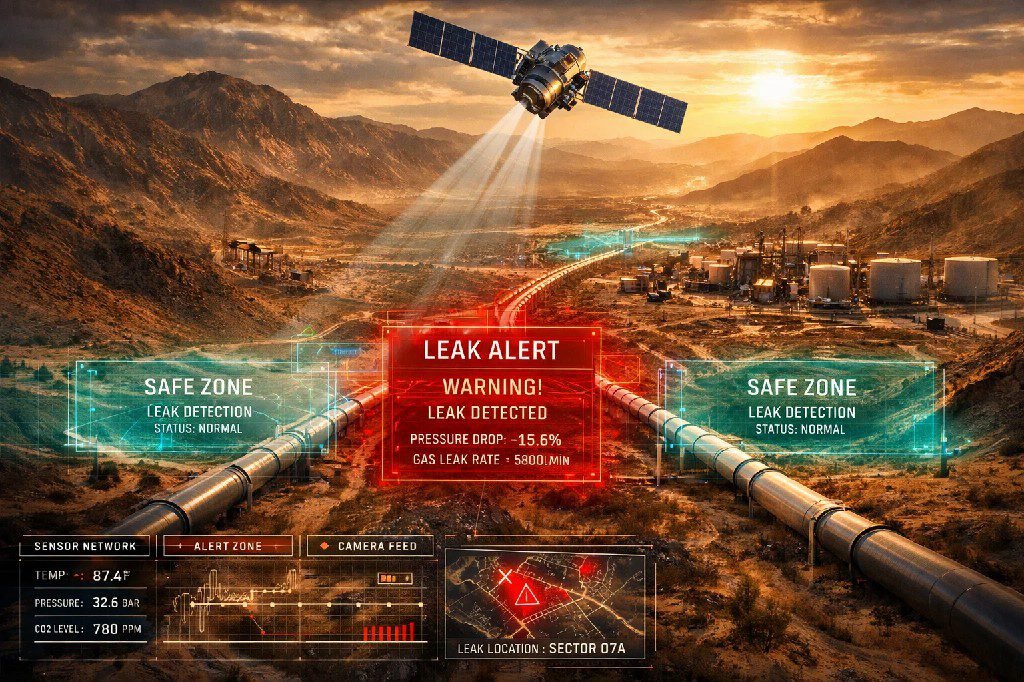
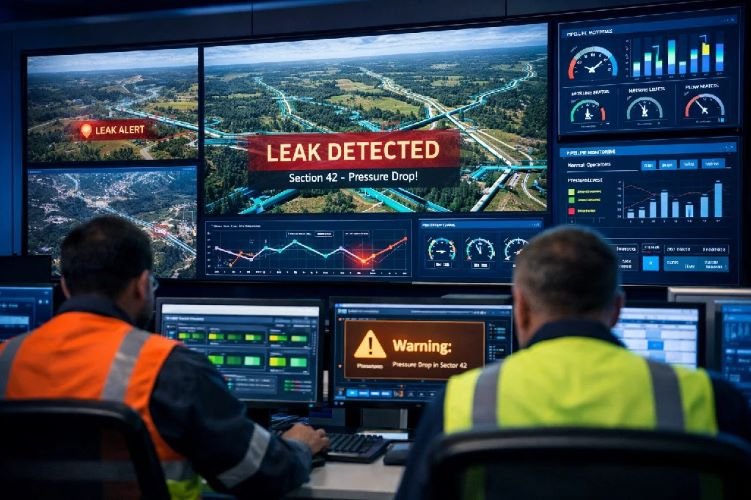
Satellite monitoring provides wide-area surveillance across entire pipeline corridors regardless of existing instrumentation. It can monitor gathering systems, remote crossings, and segments where sensor installation is impractical. It adds a detection layer that operates independently of pipeline instrumentation and can corroborate or supplement alarms from other systems.
The vegetation stress detection capability is particularly valuable because it identifies slow, chronic leaks that do not cause sudden pressure drops. These creeping leaks may persist for extended periods, causing ongoing environmental contamination while flying under the threshold of pressure-based alarms. Satellite NDVI analysis catches these releases through their environmental effects.
For Sky Intel Group, satellite-based monitoring also delivers historical baseline data. By analyzing archived imagery, we can establish pre-incident conditions that support forensic investigation if a leak does occur. This historical perspective is impossible to recreate with sensors that were not installed until after an event.
Building Your Leak Detection Strategy: A Decision Framework
Assessing Your Current Detection Capabilities and Gaps
Before selecting new leak detection services, evaluate what your existing systems can and cannot do. Start by documenting the detection methods currently in place: What instrumentation exists? What software systems analyze the data? What patrol programs supplement automated monitoring?
Identify coverage gaps where leaks could go undetected. Remote pipeline segments without sensors, areas between measurement points, gathering lines with minimal instrumentation, and rights-of-way that are patrolled infrequently all represent potential blind spots.
Review performance data from your current systems. What is the historical false alarm rate? How long has it taken to detect and locate past leaks? Have there been incidents where leaks were discovered by third parties or surface expression rather than by monitoring systems?
Benchmark your program against PHMSA leak detection requirements and industry standards. The 2025 regulations specify capabilities that advanced leak detection programs must include. API 1130, API 1160, and ASME B31.8S provide additional guidance on performance expectations.
This assessment reveals where additional capability is needed and helps prioritize investments that will deliver the greatest risk reduction.
Layered Detection: Why Multiple Technologies Outperform Single Solutions
No single leak detection technology is perfect. Each has strengths, limitations, and failure modes. A layered approach that combines multiple complementary methods achieves better overall performance than reliance on any single system.
Shell’s Design Engineering Practice guidelines explicitly recommend combining internal and external detection methods. The logic is straightforward: when one system’s weakness aligns with another system’s strength, the combination covers more scenarios than either alone.
Consider a layered program that includes RTTM software for real-time hydraulic anomaly detection, providing continuous monitoring with rapid response to significant events. Add satellite remote sensing for wide-area surveillance, covering gaps between sensors and detecting slow leaks through vegetation analysis. Include fiber optic sensing on critical segments like water crossings, high-consequence areas, or recently installed pipelines where cable installation was feasible.
This combination addresses different leak types and scenarios. RTTM catches sudden ruptures and significant flow losses. Satellite identifies chronic small leaks, encroachment threats, and corridor-wide changes. Fiber provides the highest precision on segments where it is deployed.
The integration of data from multiple sources also improves confidence in alarms. When two independent systems flag the same location, operators can respond with higher certainty that the event is real, reducing the operational cost of false positive investigations.
ROI Considerations: Balancing Detection Capability with Investment
Leak detection investments must be justified by the value they deliver. That value comes in several forms: regulatory compliance, risk reduction, avoided incident costs, and operational efficiency.
False positive costs are more significant than many operators realize. Each false alarm triggers a response: control room analysis, field crew dispatch, potential shutdown, and documentation. A PHMSA-funded study noted that even a 1.47% false alarm rate generates substantial cumulative cost across a large pipeline network with thousands of annual alerts.
Early detection generates enormous savings compared to delayed discovery. Industry sources indicate that catching leaks early can reduce cleanup costs by up to 90% compared to extended releases. When hydrocarbons spread through soil and groundwater before detection, remediation becomes exponentially more complex and expensive.
Regulatory compliance value is harder to quantify but increasingly important. The 2025 PHMSA rules mandate advanced detection programs, and operators who cannot demonstrate compliance face penalties, enforcement actions, and potential operating restrictions. Investment in detection capability protects the license to operate.
Insurance considerations also come into play. Insurers are increasingly sophisticated about pipeline integrity practices, and operators with robust detection programs may benefit from more favorable terms.
How Sky Intel Group Delivers Satellite-Based Leak Detection Services
Our Technology: Hyperspectral, SAR, and Multispectral Analysis
Sky Intel Group provides comprehensive satellite intelligence for pipeline operators, combining multiple remote sensing technologies to deliver robust leak detection and corridor monitoring.
Our hyperspectral leak detection capability identifies methane emissions and hydrocarbon signatures based on spectral analysis. When gases or liquids escape from a pipeline, they produce characteristic spectral patterns that our analysis detects against background conditions.
SAR monitoring provides all-weather, day-and-night surveillance capability. We use Differential InSAR to track ground deformation with millimeter precision, identifying subsidence, slope movement, and settling that may threaten pipeline integrity. For operators in regions with persistent cloud cover or monitoring needs in arctic winter darkness, SAR ensures continuous visibility.
Multispectral NDVI analysis detects vegetation stress caused by subsurface hydrocarbon contamination. Our algorithms compare current vegetation health against historical baselines and adjacent reference areas, flagging anomalies that may indicate leak locations before surface expression occurs.
AI-powered change detection monitors pipeline corridors for ROW encroachment detection. We identify new construction activity, unauthorized excavation, vehicle traffic increases, and other changes that may represent threats to pipeline safety. Since third-party interference is the leading cause of pipeline failures, early warning of encroachment activity provides significant risk reduction.
All findings integrate with client SCADA and GIS systems through standard data formats and API connections, ensuring that satellite intelligence flows into existing operational workflows.
What Makes Our Approach Different: No Hardware, Faster Deployment, Global Coverage
The fundamental advantage of satellite-based leak detection is that it requires no physical installation on the pipeline. Operators can begin monitoring existing infrastructure immediately without excavation, service interruption, or capital-intensive sensor deployment.
Deployment timescales reflect this advantage. Where fiber optic installation on an existing pipeline might require months of planning, permitting, and construction, satellite monitoring can begin within days of contract initiation. Historical imagery archives allow us to establish baselines and begin change detection analysis immediately.
Our monitoring scales from single pipeline corridors to transcontinental networks without proportional cost increases. The same satellite constellation covers global infrastructure, making satellite surveillance particularly cost-effective for operators with extensive or geographically distributed assets.
For pipelines in remote or difficult terrain, satellite monitoring may be the only practical option for frequent surveillance. Mountain crossings, desert routes, jungle corridors, and offshore approaches that would require expensive and infrequent helicopter patrols can be monitored regularly and affordably from orbit.
Industries We Serve: Oil, Gas, Water, and Chemical Pipelines
Our pipeline monitoring solutions serve operators across the hydrocarbon value chain and beyond.
Upstream gathering systems collecting production from wellpads often lack the instrumentation found on major transmission lines. Satellite monitoring provides coverage for these distributed, often remote gathering networks where traditional detection is sparse.
Midstream transmission pipelines benefit from satellite surveillance as a complementary layer to existing CPM and instrumentation, covering the gaps and adding vegetation stress detection capability that SCADA systems cannot provide.
Downstream distribution networks face encroachment threats in urban and suburban environments where construction activity is frequent. Satellite change detection identifies threats early.
Cross-border and international pipelines operating across multiple jurisdictions and diverse terrain types gain particular value from satellite coverage that is not constrained by national boundaries or ground access limitations.
Water utilities and chemical transporters face similar leak detection challenges and increasingly adopt satellite monitoring for pipeline corridor surveillance, similar to our work in the utilities sector.
Strengthen Your Pipeline Integrity Program with Satellite Intelligence
Contact Sky Intel Group to discuss how satellite-based leak detection can complement your existing systems, meet PHMSA compliance requirements, and protect your assets across any terrain.
Frequently Asked Questions About Leak Detection Services
What is the most accurate leak detection technology for pipelines?
No single technology is universally most accurate because accuracy depends on leak type, pipeline characteristics, and operating conditions. Fiber optic pipeline monitoring offers location accuracy within 3 meters for installed systems and excels at detecting acoustic and thermal signatures of active leaks. Satellite hyperspectral sensors detect methane and hydrocarbon signatures across vast areas but depend on revisit frequency for timing. RTTM software provides real-time detection of significant flow anomalies but may not locate leaks precisely. The most accurate programs combine multiple technologies to address different detection scenarios.
How much do pipeline leak detection services cost?
Costs vary dramatically by technology and scope. Fiber optic installation on new pipelines typically exceeds $50,000 per kilometer and can be substantially higher for retrofit installations requiring excavation. Software-based CPM systems require licensing fees, instrumentation, and ongoing calibration. Satellite monitoring costs depend on coverage area, revisit frequency, and analysis requirements but typically represents a fraction of continuous aerial patrol costs and requires no physical installation investment, making it attractive for long pipelines and existing infrastructure.
Are satellites approved for pipeline leak detection compliance?
Yes. PHMSA’s July 2025 Direct Final Rule explicitly states that satellite imaging satisfies right-of-way patrol requirements under §192.705 and §195.412. The rule specifies that patrol methods include «imaging via satellite» alongside walking, driving, and manned or unmanned aerial systems. This regulatory clarity removed uncertainty that had slowed satellite adoption and confirms that operators can incorporate satellite monitoring into compliance programs.
How quickly can satellite detect a pipeline leak?
Detection timing depends on satellite constellation revisit frequency and leak characteristics. Hyperspectral satellites identify methane emissions and hydrocarbon signatures when they pass over affected areas, with constellation revisit times ranging from daily to weekly depending on the provider. NDVI vegetation analysis can reveal subsurface leaks within days of their impact on plant health, often before surface expression or pressure-based detection. For time-critical applications, operators may combine satellite monitoring with continuous ground-based systems.
What causes most pipeline leaks?
Industry data indicates that approximately 80% of pipeline leaks result from third-party interference, primarily accidental excavation damage from construction equipment striking pipelines. This makes ROW encroachment detection a critical prevention strategy. Other causes include external corrosion, internal corrosion from transported fluids, equipment and weld failures, manufacturing defects, and natural ground movement including subsidence and seismic activity.
Can leak detection services monitor offshore pipelines?
Offshore pipelines present unique challenges because most external monitoring technologies are difficult to deploy subsea. Fiber optic systems must be incorporated during construction. Satellite monitoring can observe platform facilities, detect surface oil sheens indicating subsea releases, and track vessel activity in pipeline corridors. For subsea segments, computational methods using flow metering at platform connections remain the primary detection approach, supplemented by inspection pigging where pipeline configuration allows.
What is the difference between RTTM and CPM leak detection?
CPM (Computational Pipeline Monitoring) is the broad category of software-based detection methods defined by API 1130. RTTM (Real-Time Transient Model) is one specific CPM methodology. RTTM uses hydraulic simulation to predict expected pressure and flow conditions throughout the pipeline, comparing predictions against actual sensor readings to identify discrepancies. Other CPM methods include compensated volume balance, pressure/flow monitoring, and statistical analysis. RTTM requires detailed pipeline geometry and fluid property data but provides more precise leak characterization than simpler methods.
How does vegetation analysis detect underground pipeline leaks?
When hydrocarbons leak from a buried pipeline, they migrate through soil and contact plant root systems above. The contamination stresses vegetation, disrupting normal photosynthesis and water uptake. Stressed plants reflect light differently than healthy plants, with reduced near-infrared reflectance that satellite multispectral sensors detect. By calculating vegetation indices like NDVI and comparing against baselines, analysis identifies anomalous stress zones that may indicate subsurface leaks. This method has detected leaks days before surface expression, enabling earlier intervention.
Conclusion: Choosing the Right Leak Detection Partner for 2026 and Beyond
The leak detection services landscape has evolved significantly. Regulatory requirements have tightened with PHMSA’s 2025 Final Rule mandating advanced detection programs. Technology options have expanded with satellite monitoring now officially accepted for compliance. And the stakes have grown as environmental liability, regulatory penalties, and reputational risks increase.
No single technology solves every detection challenge. The most effective programs layer complementary methods: SCADA and CPM for continuous hydraulic monitoring, fiber optics for high-precision coverage on critical segments, and satellite surveillance for wide-area monitoring and gap coverage. This layered approach delivers detection capability that individual systems cannot achieve alone.
Selecting the right partner for your program matters as much as selecting the right technology. Look for providers with proven methodology, regulatory knowledge, integration capability, and a track record across diverse pipeline environments.
At Sky Intel Group, we bring satellite intelligence to pipeline monitoring, offering detection services that complement your existing systems without requiring physical installation. Our capabilities in hyperspectral analysis, SAR monitoring, NDVI vegetation assessment, and change detection deliver value across liquid pipelines, gas transmission, gathering systems, and remote corridors where traditional methods fall short.
For operators concerned about ground subsidence and geotechnical stability along pipeline routes, our mining sector experience in DInSAR monitoring transfers directly to pipeline applications.
The technology, the regulations, and the risks all point in the same direction: comprehensive leak detection is no longer optional. The question is how to build a program that meets compliance requirements, manages risk effectively, and does so at sustainable cost.
Ready to Strengthen Your Pipeline Integrity Program?
Contact Sky Intel Group today to explore how our satellite-based leak detection services can help you meet PHMSA requirements, reduce environmental risk, and protect your assets worldwide.