
Virtual Singapore Digital Twin: How LiDAR and Satellite Mapping Saved $29 Million in Urban Planning
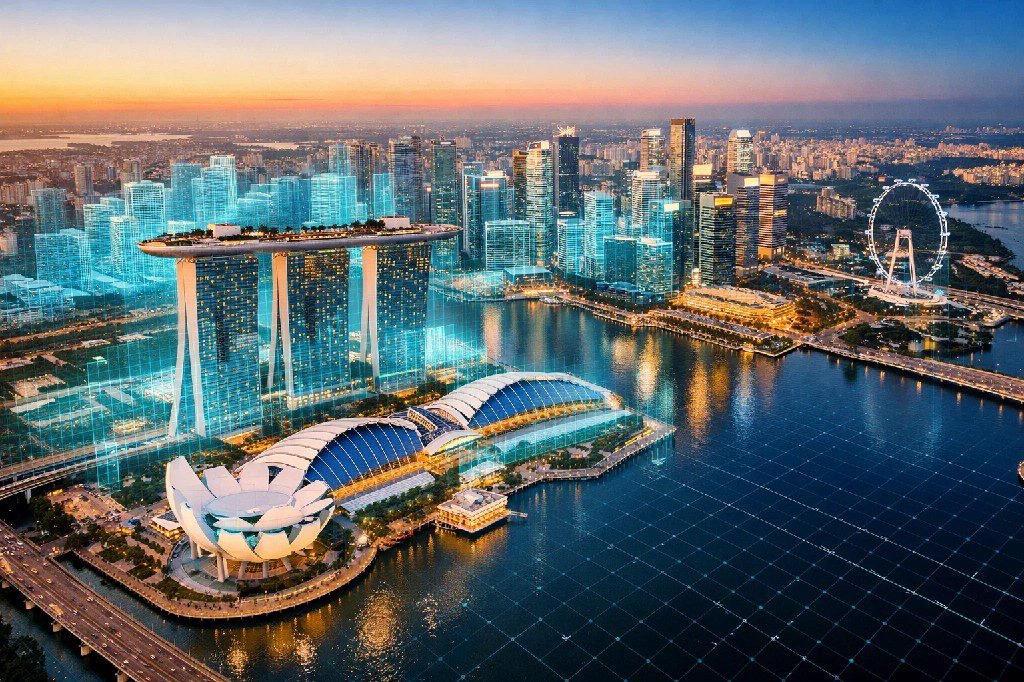
Singapore faces a challenge that few nations understand at such an acute level: how do you plan infrastructure, manage emergencies, and optimize resource allocation when every square meter of land is precious and over 5.6 million people share an island smaller than New York City? For decades, the answer involved separate government agencies conducting independent topographical surveys, duplicating efforts, and spending SGD $35 million every time the nation needed updated mapping data. The process consumed 24 months and produced datasets that often conflicted across departments.
Then came 2011, when nine damaging flash floods struck the city-state in rapid succession. The disasters exposed critical gaps in Singapore’s ability to model flood risk, simulate emergency responses, and coordinate infrastructure planning across agencies. The government recognized that reactive approaches to urban management were no longer sustainable. What Singapore needed was a comprehensive digital twin for urban planning that could unify all geospatial data onto a single authoritative platform.
The result was Virtual Singapore, the world’s first national-scale digital twin, completed in 2022 after a SGD $73 million investment. This case study examines how the project reduced mapping costs by 83%, cut delivery time by 67%, and established a new paradigm for data-driven urban governance that cities worldwide are now racing to replicate.
The Challenge: Duplicate Surveys, Flash Floods, and the World’s Densest Urban Landscape
Singapore holds the distinction of being the most densely populated nation in the world among countries with populations exceeding one million. This geographic constraint means that urban planning decisions carry consequences that ripple across the entire island. A poorly positioned building affects wind flow for neighboring structures. An underestimated drainage capacity creates flood risk for thousands of residents. A miscalculated shadow analysis reduces solar energy potential across entire districts.
Before Virtual Singapore, each government agency maintained its own topographical surveys conducted on different timelines using varying methodologies. The Singapore Land Authority collected one dataset. The Public Utilities Board gathered another. The Civil Aviation Authority of Singapore required its own specifications. This fragmentation created what officials described as a «capture many, use once» problem, where taxpayer money funded redundant data collection efforts that rarely aligned across departments.
The Pre-Digital Twin Reality
The 2011 floods served as a catalyst for change. Torrential rain events overwhelmed drainage systems across the island, causing property damage and disrupting transportation networks. Post-event analysis revealed that existing 2D maps and siloed datasets were insufficient for modeling complex flood scenarios or coordinating emergency response across multiple agencies. Singapore needed a unified platform where planners could simulate flooding, test infrastructure changes, and evaluate emergency evacuation procedures before implementing them in the physical world.
Beyond flood risk, the government faced mounting pressure to optimize land use in a nation where vertical and horizontal expansion had reached practical limits. Underground infrastructure was becoming increasingly congested. Solar energy deployment required precise shadow analysis across millions of building surfaces. Wind flow patterns needed modeling to ensure thermal comfort in new developments. None of these challenges could be addressed effectively without a comprehensive 3D model that captured not just geometry, but semantic understanding of every urban element.
Why Traditional Mapping Approaches Were Failing
The fundamental limitation of conventional surveying was its static nature. By the time a mapping project concluded after 24 months of data collection and processing, portions of the dataset were already outdated. New buildings had risen. Roads had been modified. The gap between physical reality and digital representation widened with each passing month.
Additionally, traditional maps captured geometry without context. A 2D representation could show a building’s footprint, but it could not indicate the building’s height, roof material, window orientation, or how shadows from that structure would fall on neighboring properties at different times of day. Urban planners working with such limited data were forced to make decisions based on incomplete information, accepting risks that could be avoided with richer datasets.
The cost structure was equally problematic. At SGD $35 million per national mapping cycle, comprehensive updates were financially prohibitive on any frequent schedule. Agencies deferred updates, extending the useful life of outdated data and compounding the accuracy problems that followed.
The Solution: Building the World’s First National-Scale Digital Twin for Urban Planning
In December 2014, Singapore officially launched the Virtual Singapore initiative as part of its broader Smart Nation program. The project brought together the National Research Foundation under the Prime Minister’s Office, the Singapore Land Authority, and the Government Technology Agency, with technology partnerships from Dassault Systèmes and Bentley Systems.
The strategic vision was encapsulated in a phrase that would guide the entire project: «capture once, use by many.» Rather than allowing each agency to conduct independent surveys, Virtual Singapore would create an authoritative 3D model that all government departments, research institutions, and eventually private sector partners could access through a unified platform.
Multi-Modal Data Acquisition Strategy
The data capture methodology combined airborne and terrestrial technologies to achieve unprecedented coverage and detail. The Singapore Land Authority commissioned the AAM Group to execute aerial surveys using aircraft equipped with high-resolution cameras and LiDAR mapping for smart cities applications. Over a period of just 41 days, the aerial campaign captured more than 160,000 high-resolution images covering the entire nation.
These images were processed using Bentley Systems’ ContextCapture software to generate a reality mesh with 0.1-meter accuracy, meaning that features as small as 10 centimeters could be reliably distinguished in the resulting 3D model. The reality mesh provided photorealistic visualization while maintaining geometric precision suitable for engineering applications.
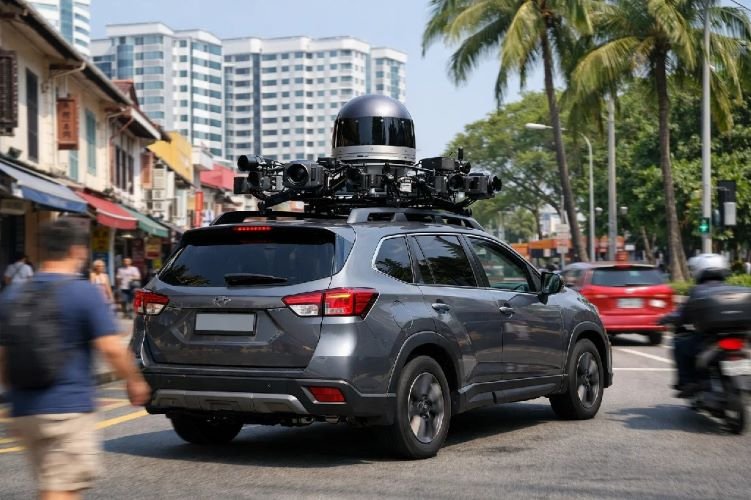
To supplement the aerial coverage with street-level detail, GPS Lands Singapore conducted a vehicle-based mobile mapping survey across the nation’s entire 5,500-kilometer road network. Survey vehicles equipped with roof-mounted LiDAR scanners and camera arrays captured more than three million images and over 600 million LiDAR points as they traversed every accessible roadway. This terrestrial data provided detailed 3D models of building facades, street furniture, signage, and other elements that aerial imagery alone could not adequately resolve.
The combined dataset exceeded 50 terabytes, representing one of the largest geospatial data collection efforts ever undertaken for a single urban area. Processing this volume of information required Bentley’s MicroStation software optimized for rapid data manipulation, achieving a final modeling accuracy of 0.3 meters across the entire platform.
Data Acquisition Specifications
Airborne Campaign
- Aerial images: 160,000+
- Capture duration: 41 days
- Reality mesh accuracy: 0.1 meters
- Processing software: Bentley ContextCapture
- Coverage: Entire nation
Terrestrial Campaign
- Road network surveyed: 5,500 km
- Street-level images: 3+ million
- LiDAR points: 600+ million
- Final accuracy: 0.3 meters
- Total data volume: 50+ terabytes
Semantic Intelligence: Beyond Geometry
What distinguished Virtual Singapore from conventional 3D city models for urban development was its semantic layer. The platform did not simply render buildings as geometric shapes. Instead, each element carried contextual metadata that enabled sophisticated queries and simulations.
Dr. Ronnie Lee, Deputy Director of GovTech’s Geospatial Specialist Office, explained the capability: «The fact that the computer knows all this information means that more advanced simulation and analysis can be carried out. You could for example find all the roof surfaces for buildings of a certain height in a certain area, or find all the wall surfaces oriented at a certain bearing and calculate the amount of sunlight falling on them.»
This semantic understanding enabled applications that static 3D models could never support. Planners could query the system to identify every building with rooftop area exceeding a specified threshold and southern exposure optimal for solar panel installation. Emergency responders could model crowd dispersal from the new Sports Hub to simulate evacuation procedures before any actual emergency occurred. Transportation analysts could study pedestrian movement patterns across park connector networks to identify bottlenecks and optimize flow.
The platform integrated data from multiple government agencies including OneMap, People Hub, and Business Hub, enriching the 3D geometry with demographic information, business registrations, and real-time sensor feeds from IoT devices deployed across the Smart Nation infrastructure.
Quantified Results: 83% Cost Reduction and 3,000 Resource Days Saved
The financial impact of Virtual Singapore exceeded initial projections. By consolidating mapping efforts onto a single platform and eliminating redundant surveys across agencies, the project achieved dramatic cost and time efficiencies that fundamentally changed how Singapore approaches geospatial data management.
Before and After Virtual Singapore
| Metric | Before | After | Improvement |
|---|---|---|---|
| National Mapping Cost | SGD $35 million | SGD $6 million | 83% reduction |
| Time to Complete | 24 months | 8 months | 67% reduction |
| Resource Days Saved | Baseline | 3,000+ days | Operational efficiency |
| Road Mapping Savings | — | SGD $25+ million | Cumulative savings |
The Singapore Land Authority reported saving over SGD $25 million through more accurate and efficient road mapping enabled by the digital twin platform. These savings accumulated through reduced planning time, fewer field verification visits, and elimination of conflicts between inconsistent datasets maintained by different agencies.
Beyond direct cost savings, the platform enabled capabilities that were previously impossible or prohibitively expensive. Alexander Parilusyan, Vice President at Dassault Systèmes, noted that researchers can now «use this model to do very large-scale simulations, like wind, noise, traffic simulation» without the months of data preparation that such analyses previously required.
Operational Applications Transforming Urban Governance
The Housing and Development Board (HDB), responsible for Singapore’s public housing where over 80% of residents live, now uses environmental simulation tools integrated with Virtual Singapore data to maximize wind flow and optimize solar panel placement in new developments. Through computational fluid dynamics, planners arrange residential blocks to capitalize on prevailing wind patterns, channeling airflow into precincts and individual residential spaces to reduce cooling loads and improve thermal comfort.
Solar irradiance simulations guide facade design, helping architects minimize heat gain into residential units while identifying naturally shaded areas suitable for community facilities like playgrounds. Shadow analysis ensures that new developments do not adversely impact neighboring buildings’ access to natural light.
For emergency management, the digital twin enables simulation of crowd dispersal scenarios at major venues like the Sports Hub. By modeling how tens of thousands of spectators would evacuate under various emergency conditions, authorities can optimize exit placement, signage, and emergency response deployment before any actual crisis occurs.
The platform also supports flood risk analysis by combining the 3D terrain model with drainage network data and precipitation scenarios. Planners can visualize which areas would be inundated under different rainfall intensities, informing both infrastructure investment priorities and emergency response protocols.
Expansion into Subsurface Infrastructure
Recognizing that a significant portion of Singapore’s utility infrastructure lies underground, the Singapore Land Authority has embarked on the next phase: creating a national subsurface digital twin in collaboration with the Singapore-ETH Centre under ETH Zurich. This Digital Underground project addresses the growing complexity of subterranean space as Singapore expands both vertically and horizontally.
Capturing and maintaining reliable information about underground utilities delivers multiple benefits. It reduces the risk of accidental damage during construction or excavation work. It enables more efficient coordination when multiple utilities need maintenance in the same area. And it supports long-term planning for underground infrastructure expansion as surface-level options become increasingly constrained.
How SkyIntelGroup Delivers Digital Twin Foundations for Smart Cities
Virtual Singapore demonstrates what becomes possible when governments invest in comprehensive geospatial data infrastructure. The transformation from fragmented, outdated surveys to a unified, semantically rich digital twin enabled applications that were previously unimaginable. Cities worldwide are now pursuing similar initiatives, recognizing that satellite imagery for city planning and LiDAR-derived 3D models provide the foundation for data-driven urban governance.
SkyIntelGroup provides the geospatial intelligence services that enable organizations to build digital twin foundations for their own urban environments. Our smart cities solutions combine satellite remote sensing, aerial photogrammetry, and LiDAR data processing to deliver the high-resolution 3D models and semantic datasets that power modern urban planning platforms.
For municipal governments seeking to replicate Singapore’s success, we offer comprehensive data acquisition services using multi-modal capture strategies similar to those employed in the Virtual Singapore project. Our photogrammetric processing generates reality meshes with centimeter-level accuracy, while our LiDAR point cloud analysis extracts detailed terrain models, building footprints, and vegetation coverage suitable for flood modeling, solar analysis, and infrastructure planning.
For urban planners evaluating development proposals, our shadow analysis and solar irradiance modeling quantify how new construction will affect neighboring properties. For emergency management agencies, our 3D city models support evacuation simulation and emergency response planning. For utility companies managing underground infrastructure, our subsurface mapping capabilities help prevent costly damage during excavation projects.
The lesson from Virtual Singapore is clear: investment in geospatial infrastructure pays dividends across virtually every domain of urban governance. The 83% cost reduction and 67% time savings achieved by Singapore represent returns that justify comprehensive digital twin initiatives even in cities with more constrained budgets.
Build Your City’s Digital Twin Foundation
SkyIntelGroup delivers the LiDAR, satellite imagery, and 3D modeling services that power smart city initiatives. From flood risk analysis to solar optimization, our geospatial intelligence supports data-driven urban planning.
Verified Source Links
- GovTech Singapore. 5 Things to Know About Virtual Singapore. https://www.tech.gov.sg/technews/5-things-to-know-about-virtual-singapore/
- Geospatial World. Virtual Singapore – Building a 3D-Empowered Smart Nation. https://geospatialworld.net/prime/case-study/national-mapping/virtual-singapore-building-a-3d-empowered-smart-nation/
- OECD Observatory of Public Sector Innovation. Virtual Singapore – Singapore’s Virtual Twin. https://oecd-opsi.org/innovations/virtual-twin-singapore/
- Experion Global. Virtual Singapore: A Digital Gateway to Urban Innovation. https://experionglobal.com/virtual-singapore/
- Infrastructure Global. Singapore’s Digital Twin – From Science Fiction to Hi-Tech Reality. https://infra.global/singapores-digital-twin-from-science-fiction-to-hi-tech-reality/
- Structures Insider. Singapore’s First Country-Scale Digital Twin and The Future of Digital Open Data. https://www.structuresinsider.com/post/singapore-s-first-country-scale-digital-twin-and-the-future-of-digital-open-data